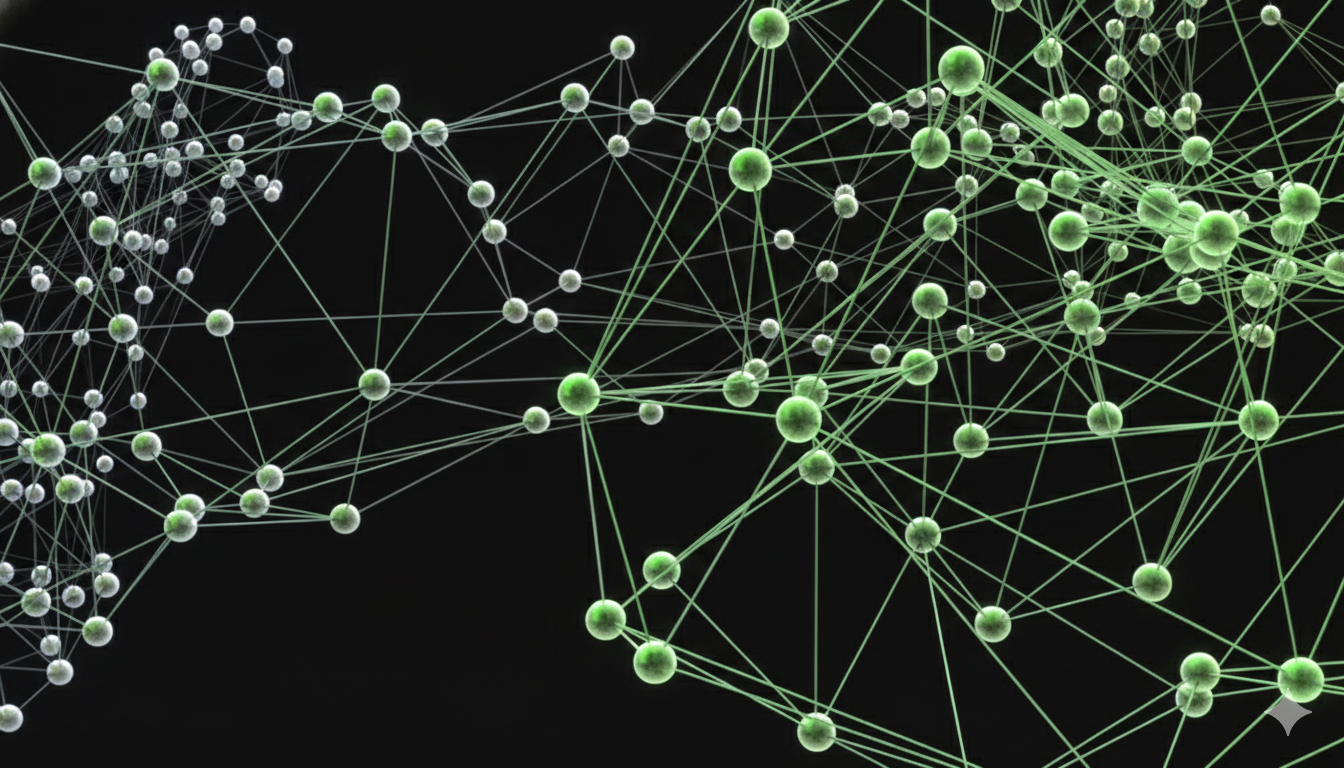
The Fabric of Complexity
Networks are everywhere. They are the interconnected substrate of every complex system—from the human brain to the global economy.
In the Intelligence Age, our understanding of the world depends entirely on our understanding of these networks. We are witnessing a Network Revolution, where the "fabric" of our organizations matters more than the boxes on an org chart.
To survive the existential threats of the Post-Knowledge Work Era, we must master two key principles of Complexity Science: Adaptation and Resiliency. These are not buzzwords; they are the survival mechanisms of a specific type of structure: the Scale-Free Network.
1. The Death of Certainty (and the Rise of Weak Signals)
Legacy organizations were built for certainty. They operated in closed systems where inputs led to predictable outputs. That world is gone.
We now operate in Complex Adaptive Systems (CAS). In this environment, the only absolute is that any intervention will create unintended consequences.
- The Challenge: You cannot control a complex system; you can only navigate it.
- The Solution: You need fast feedback loops throughout your informal network.
We must treat employees not as cogs, but as a Human Sensor Network. Their tacit knowledge detects the "weak signals" of change long before leadership sees the data. In an AI-first world, these human insights are the critical inputs for AI agent adoption.
2. Networks as the New Competitive Advantage
Why have 70% of digital transformations failed? Because they tried to force linear change onto a complex system with a declining Metabolic Health due to a high degree of entropy.
Today, Networks are the new competitive advantage.
- The Value Network: We must manage the informal network as the primary organizing construct, say within a value network construct. It allows us to orchestrate value with Value Consumers (customers), Value Producers, and Value Partners dynamically.
- The AI Multiplier: We are no longer just restructuring human capital. We are integrating an entire network of Ph.D.-level AI agents (with IQs of 130+) into our value network and value streams.
The strategic question is no longer "Who reports to whom?" but "Where do we place our AI agents within the network for maximum flow?"
3. Disruption, Decoupling, and the "Fractional" Future
Disruption is happening, but it doesn't have to mean destruction. It does, however, mean Disintermediation.
Agentic AI is supercharging the removal of middlemen—including knowledge workers who act as "human middleware" in legacy processes.
- The Imperative: Value Producers must proactively decouple the value they create from their employer's operating model that often contain rigid, deterministic processes. At the same time, Value Consumers plugging their entire organization into a Center for Enablement (C4E) to enable their internal knowledge workers to become AI Generalists.
- The Opportunity: As author Rishad Tobaccowala outlines in his book Rethinking Work, we may see the rise of the "Fractionalized Employee"—someone who works 50-75% of the time, retaining benefits while pursuing other passions.
This "decoupling" of hyper-specialization is critical. If we don't fix the "silos of knowledge," specialized workers will find themselves in direct competition with rapidly advancing State-of-the-Art (SOTA) LLMs.
4. The Game Theory of AI Networks
How do we predict the future of these networks? We turn to Game Theory.
As stated in Networks, Crowds, and Markets, game theory studies strategic interactions where your satisfaction depends on the decisions of others. In the Intelligence Age, "others" includes AI agents—and the entire System of Agents, multi-agent systems that communicate with each other.
We are entering an era of Evolutionary Game Theory.
- Biological Roots: Just as an organism's genes determine its fitness in an environment, an organization's network structure determines its fitness in the market.
- Cooperative vs. Non-Cooperative: Will we see ecosystems where AI agents cooperate for mutual benefit, or a "Prisoner's Dilemma" of data hoarding?
As Seth Rosenberg from Greylock notes, we are moving from networks that connect people to content, to algorithms that replace people.
The Path Forward
The transition to an AI-Only Network is not guaranteed, but the influence of AI is inevitable. We must reimagine everything—strategies, business models, operating models, and value chains—through the lens of the network.
The network is not just how we connect. It is how we survive.
Connect with The Value Network here or on X: @vCIO_Services
Attribution & Acknowledgement
This blog draws upon the insightful work of the amazing, previously attributed authors and thought leaders who have generously shared their research and ideas. In many cases, The Value Network has intentionally included direct quotes to properly attribute their contributions and maintain the integrity of their original thoughts, in the context for which they were stated. While we have taken care to avoid misinterpreting the source material, the conclusions drawn in this blog are our own and reflect our current understanding and coherence within an ongoing discovery and learning process. As such, the author of this post is accountable for any misrepresentations that may arise.
Thanks for reading.
The Signal